
Recent Artworks
ERICA WEE
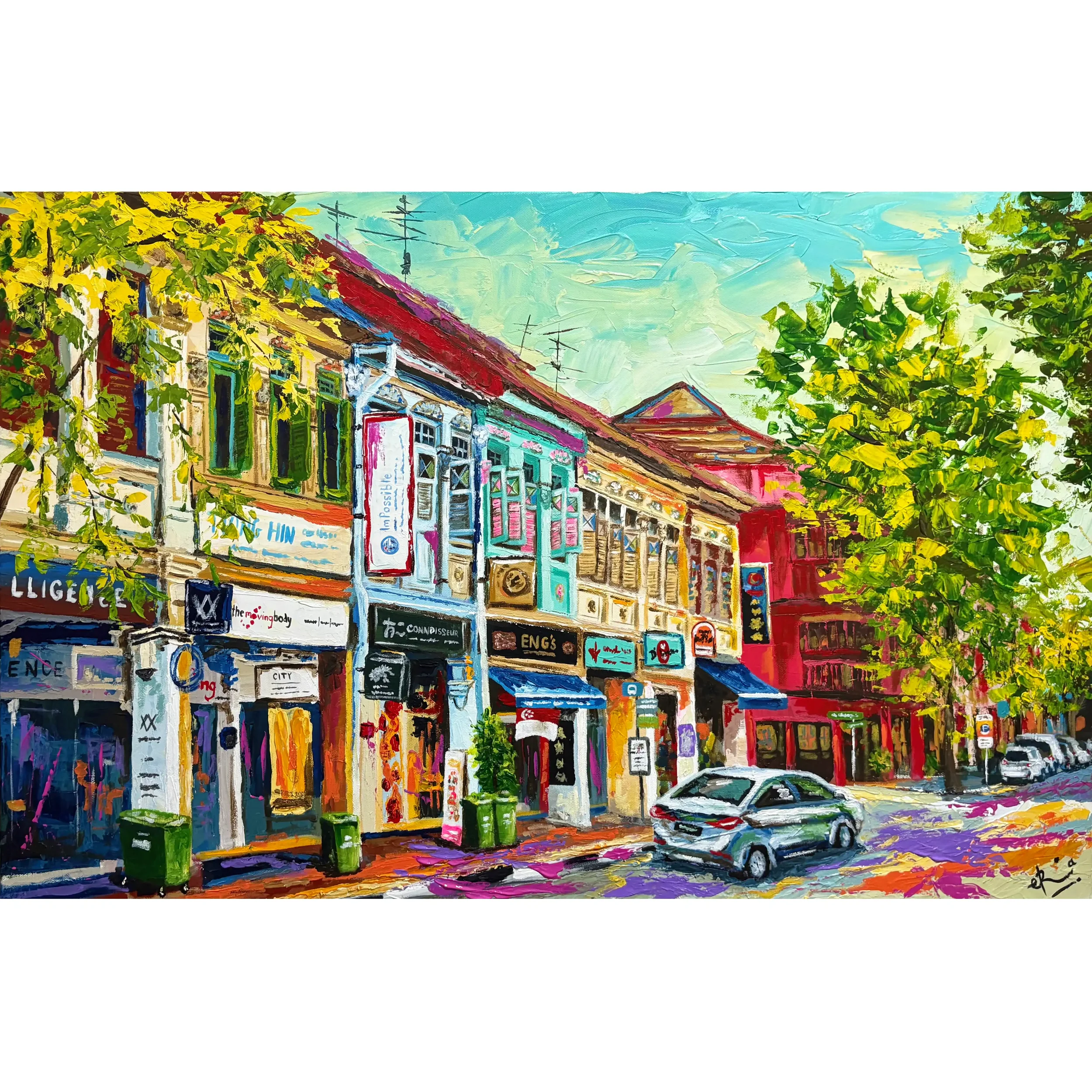
56 × 86cm
Acrylic on Canvas
2026
Capturing the lively interplay of heritage and modern life, this piece brings Singapore’s iconic neighbourhood to life through thick impasto brushwork. Bold geometric forms trace ornate Peranakan shophouses, contrasting vibrant pastel facades and colourful shutters with modern commercial signboards.
This seamless blend of old-world charm and modern urban vitality is precisely what gives Joo Chiat its unique soul, creating a dynamic energy that weaves through this eclectic tapestry.
ERICA WEE
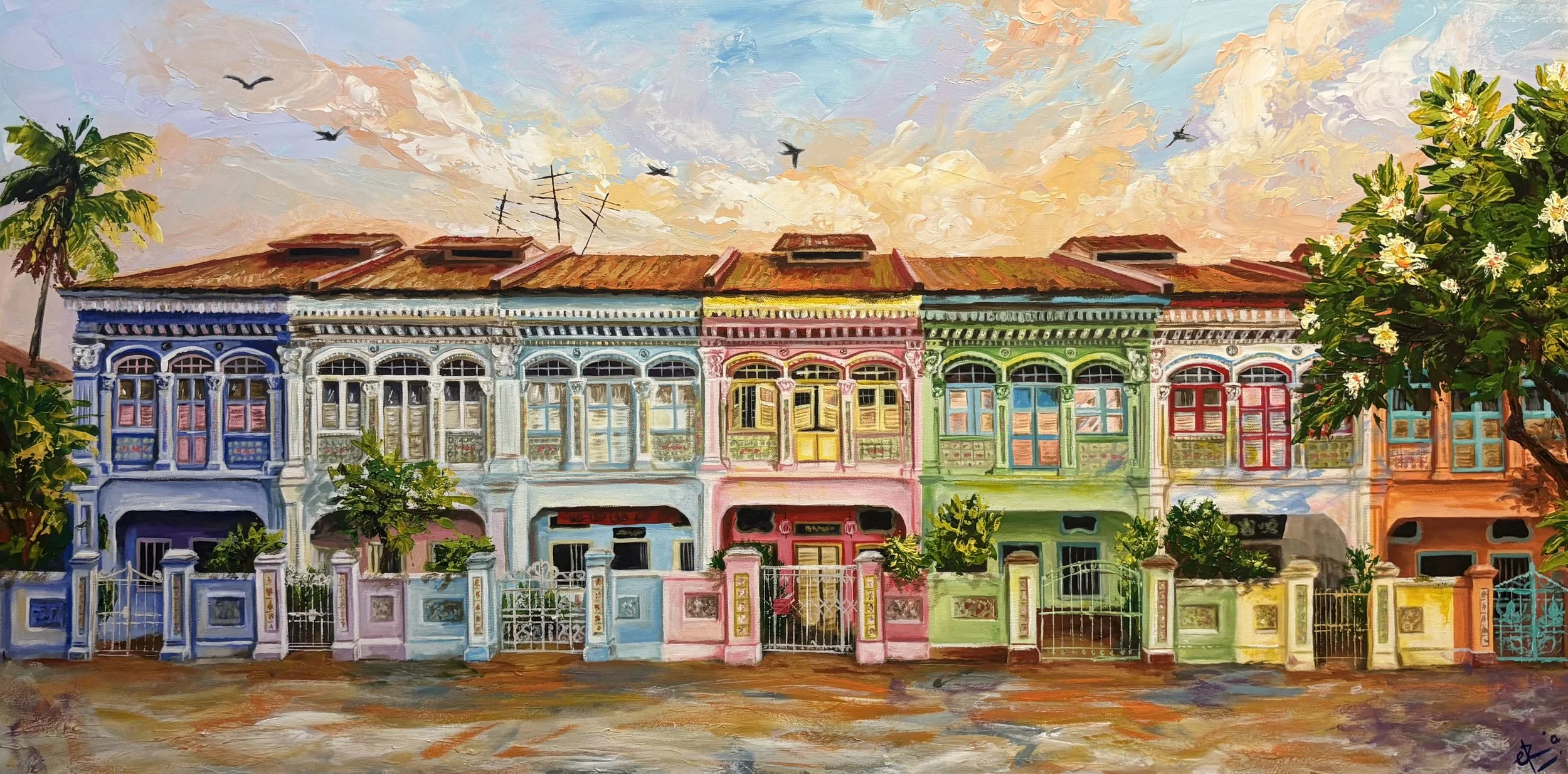
61 × 122cm
Acrylic on Canvas
2026
“A historic postcard for Katong, but a deeply personal canvas of memories for me.”
Today, this iconic row of pastel-hued 1920s Peranakan shophouses stands as a living bridge between the past and the present. Rich with traditional pintu pagar (saloon doors) and ornate majolica tiles, these walls represent a shared heritage shaped by generations of people from all backgrounds—while serving as the intimate backdrop to my own years living on this street, where personal memories intersect with a diverse community history.
ERICA WEE
60 × 90cm
Acrylic on Canvas
2026
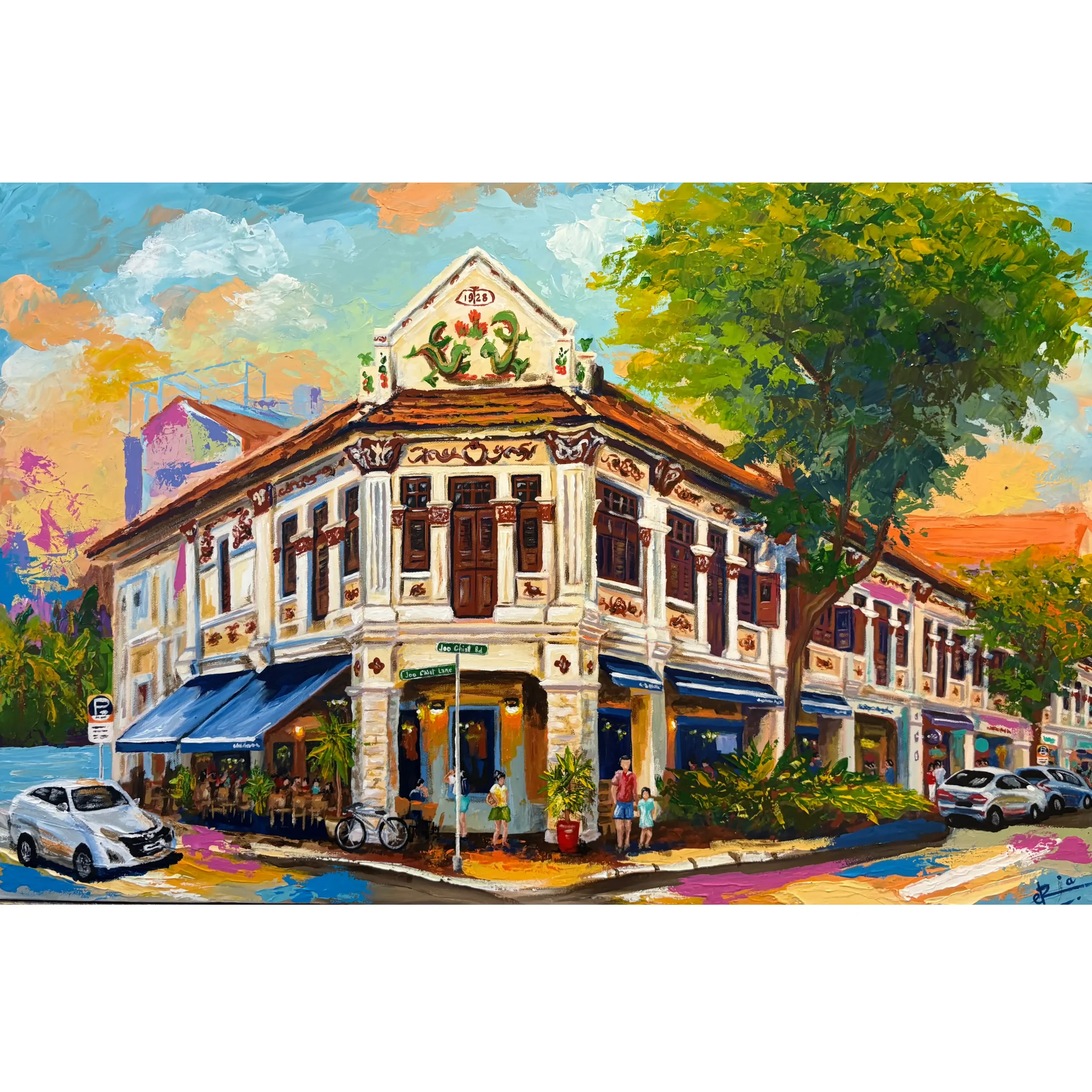
Vibrant sky tones and rich acrylic layers illuminate this storied corner where Katong’s past meets its present.
Long before it welcomed today’s coffee lovers at Common Man Coffee Roasters, 185 Joo Chiat Road was the original birthplace of Guan Hoe Soon, Singapore’s oldest Peranakan restaurant. It was here that Hainanese founder Yap Chee Quee first shared his labor-of-love Nyonya recipes with the neighborhood.
Though the flavors and eras have evolved, the soul of this corner endures—a place to “Gather at the Crossroads”, where shared moments and good food continue to connect generations.
ERICA WEE
58 × 88cm
Acrylic on Canvas
2026
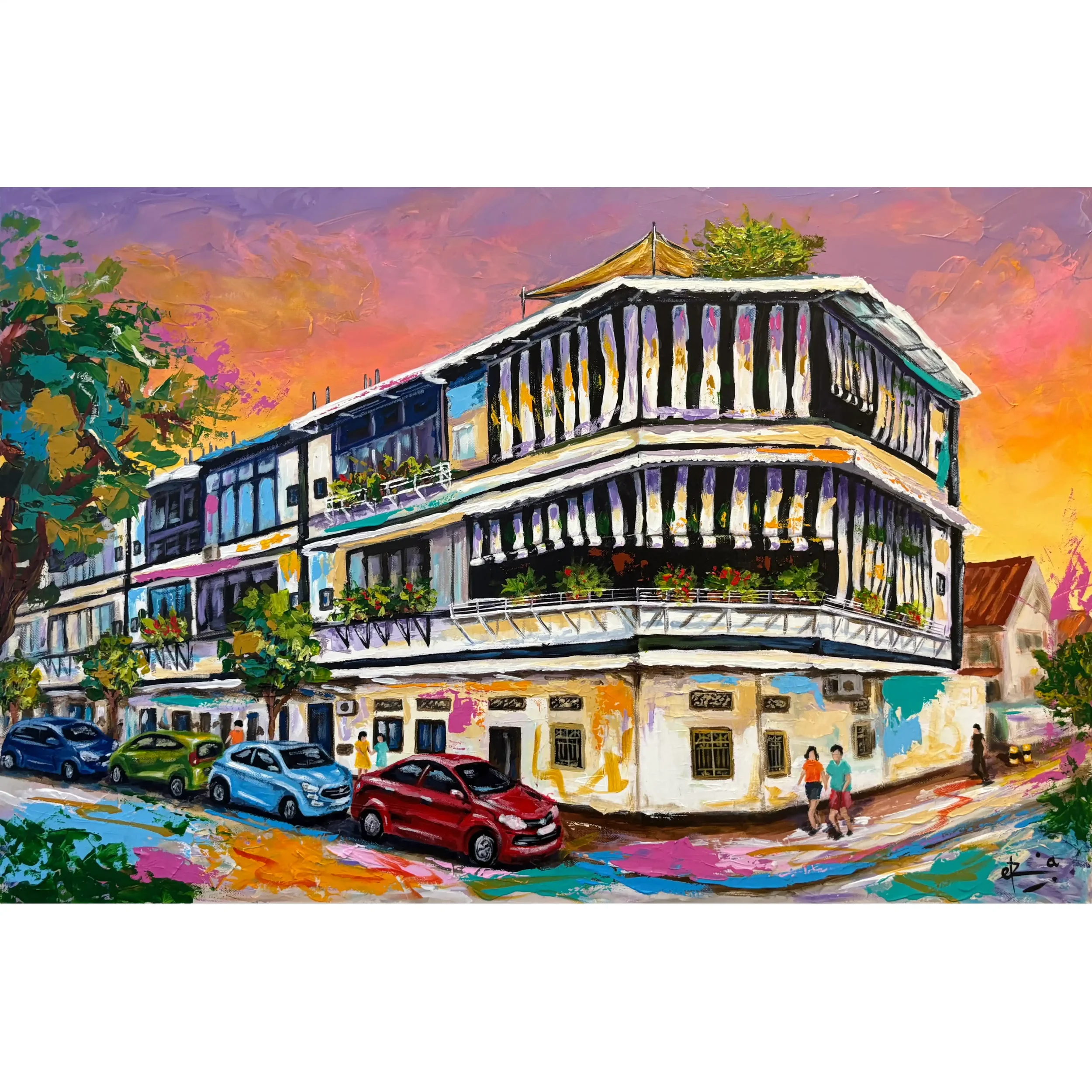
Set against a warm Katong sunset, this piece captures the quiet nostalgic charm of Stangee Place. Tracing its roots back to Katong’s colonial era, the street’s conserved black-and-white architecture remains a rare link to Singapore's early 20th-century past. Through rich impasto textures and vibrant colours, the artwork bridges this historic heritage with the lively rhythm of its modern neighborhood today.
ERICA WEE
58 × 88cm
Acrylic on Canvas
2026
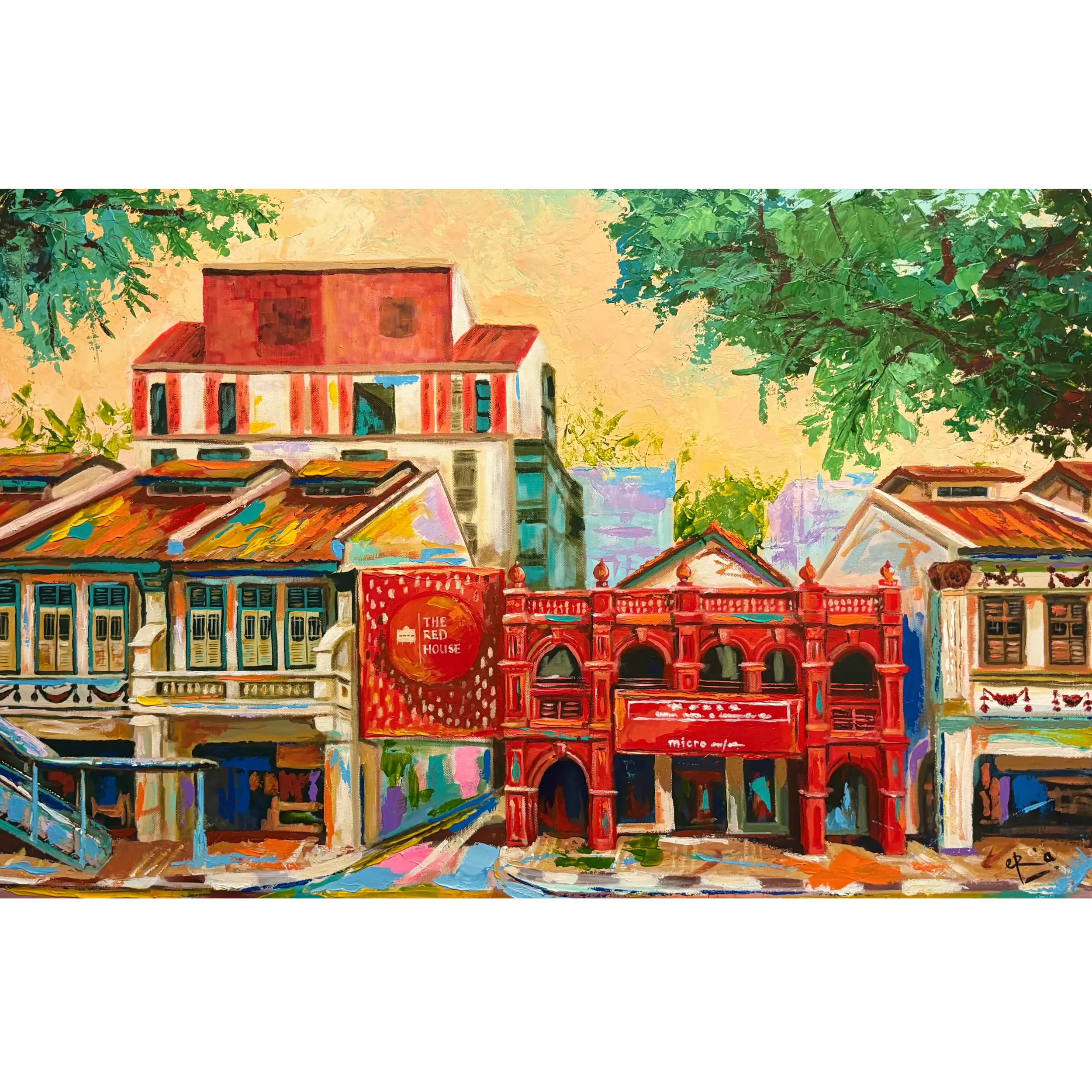
At the heart of East Coast Road, the iconic Red House Bakery has preserved generations of quiet mornings, shared stories, and warm memories. Here, past meets present seamlessly—a reminder that while Katong evolves around us, its rich heritage remains deeply rooted.
ERICA WEE
76 × 101cm
Acrylic on Canvas
2026
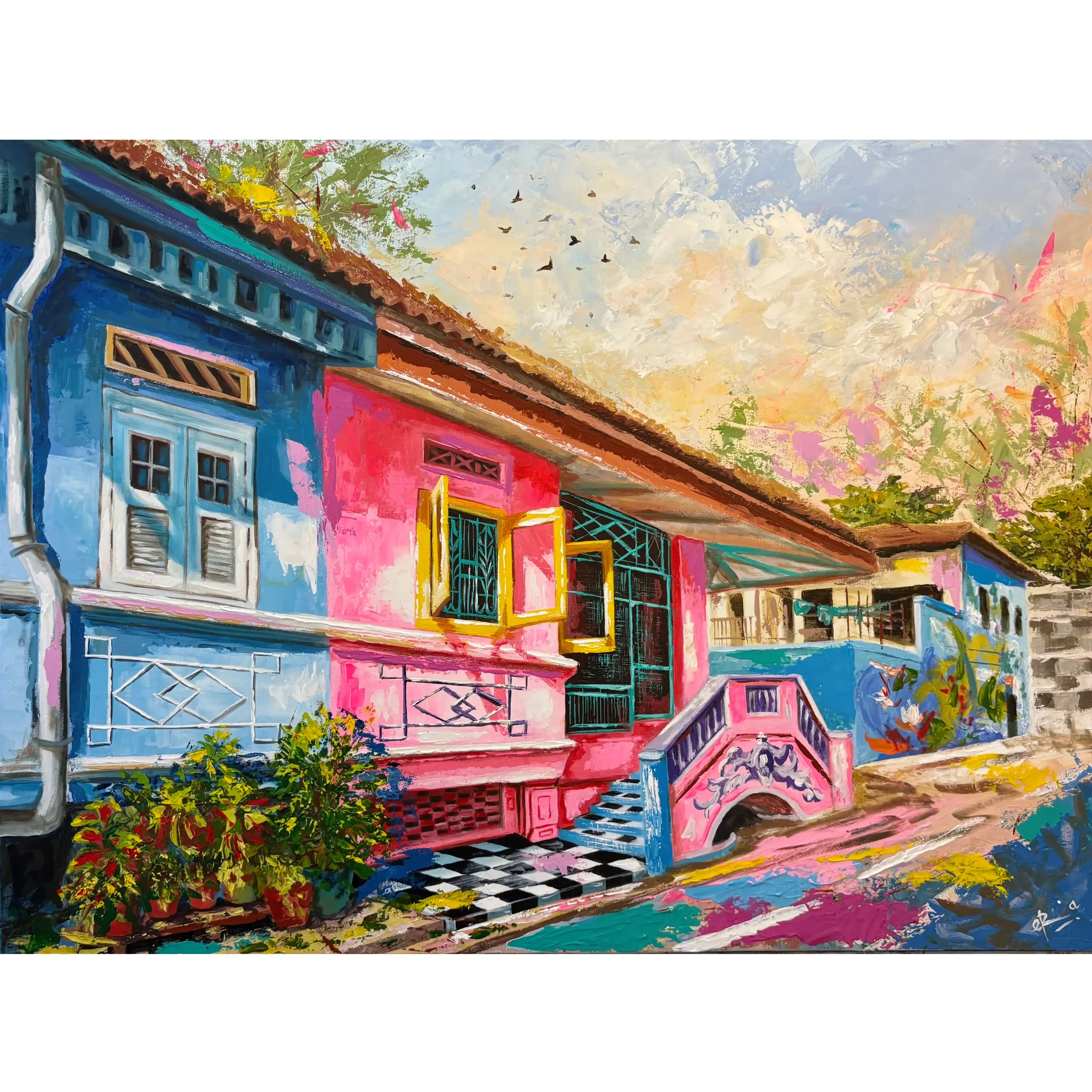
Today, they sit inland, but these historic Katong homes were originally built to greet the sea. Through expressive, textured brushwork, this piece highlights their unique architectural legacy - anchored by the seafront, with raised foundations and ornate steps designed to weather early 20th-century high tides. It is a vivid window into Singapore's changing coastline and an enduring cultural identity, standing proud against the shifting tides of time.
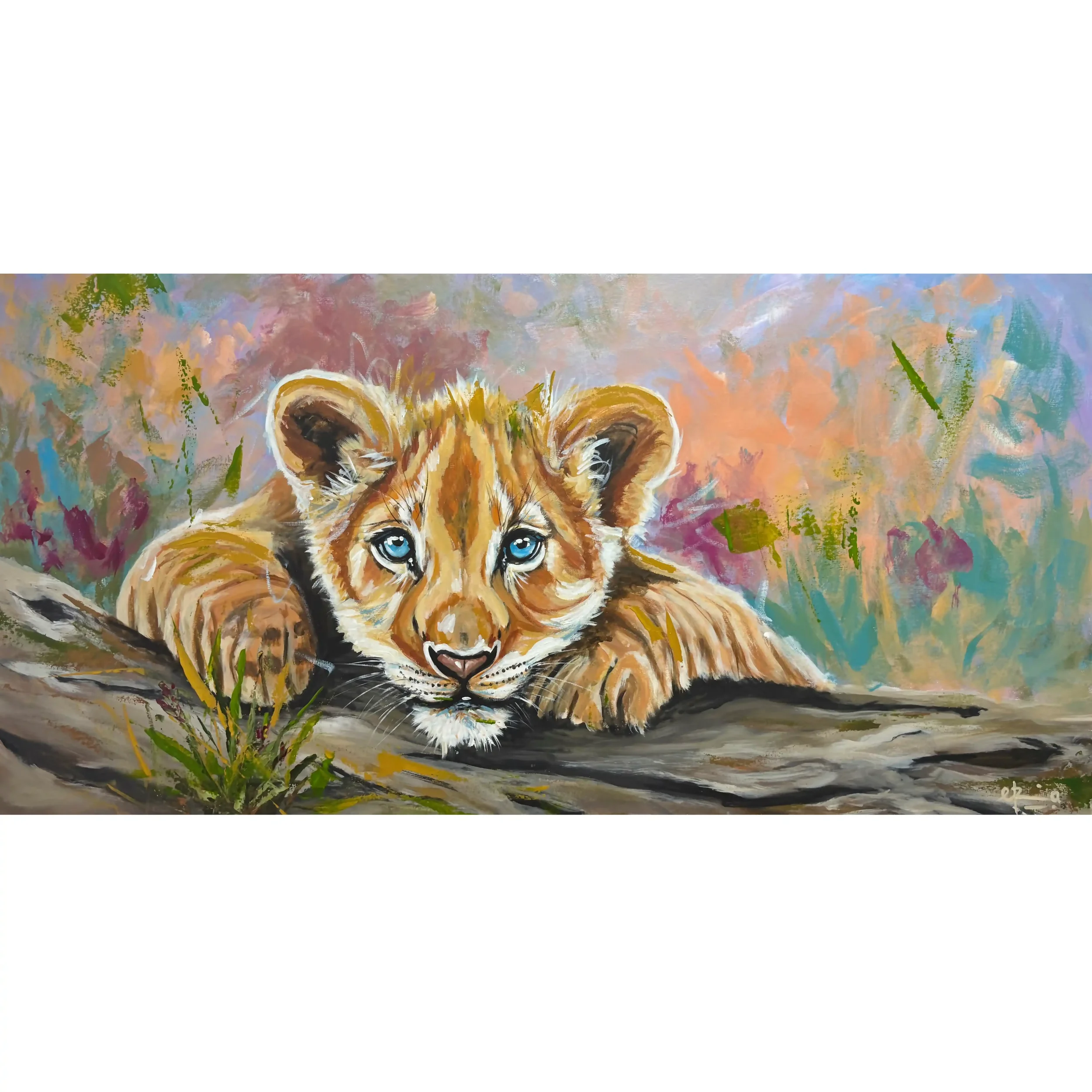
ERICA WEE
60 × 120cm
Acrylic on Canvas
2026
“Curiosity will conquer fear even more than bravery will.” — James Stephens
Peeking over a weathered log, a young lion cub stands at the edge of the unknown. Though the unfamiliar can be daunting, his striking eyes reveal an eager sense of adventure and discovery.
This piece captures the moment when curiosity overcomes fear, reminding us that while stepping into the unknown may be intimidating, the vibrant world waiting on the other side is always worth exploring.

ERICA WEE
91 × 122cm
Acrylic on Canvas
2026
In the golden light of a quiet morning, the architecture of Koon Seng Road’s iconic shophouses softens. Through a lens of delicate, blooming foregrounds, this piece captures a dialogue between the enduring strength of heritage architecture and the ephemeral, fleeting beauty of nature. It is a moment of stillness—where the past speaks in hushed, floral tones.
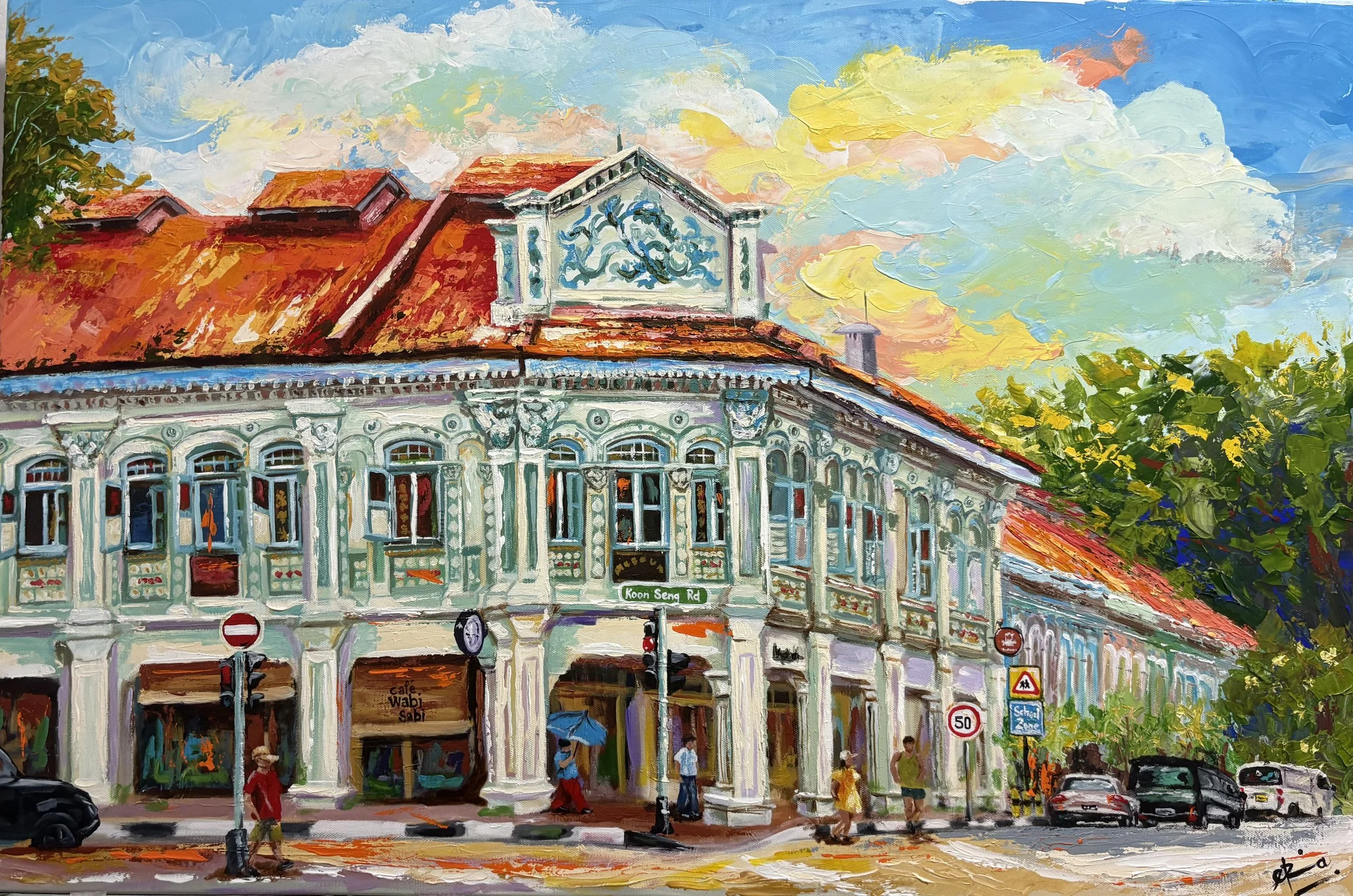
ERICA WEE
61 × 91cm
Acrylic on Canvas
2026
At the vibrant intersection of Joo Chiat and Koon Seng, Bustle On The Bend captures a living heritage. From long-time residents to curious explorers, people from all walks of life and all nationalities cross paths here, each adding their own rhythm to the street. Through thick, energetic brushstrokes, this piece celebrates the collective spirit of the generations who keep the heart of this neighbourhood beating.
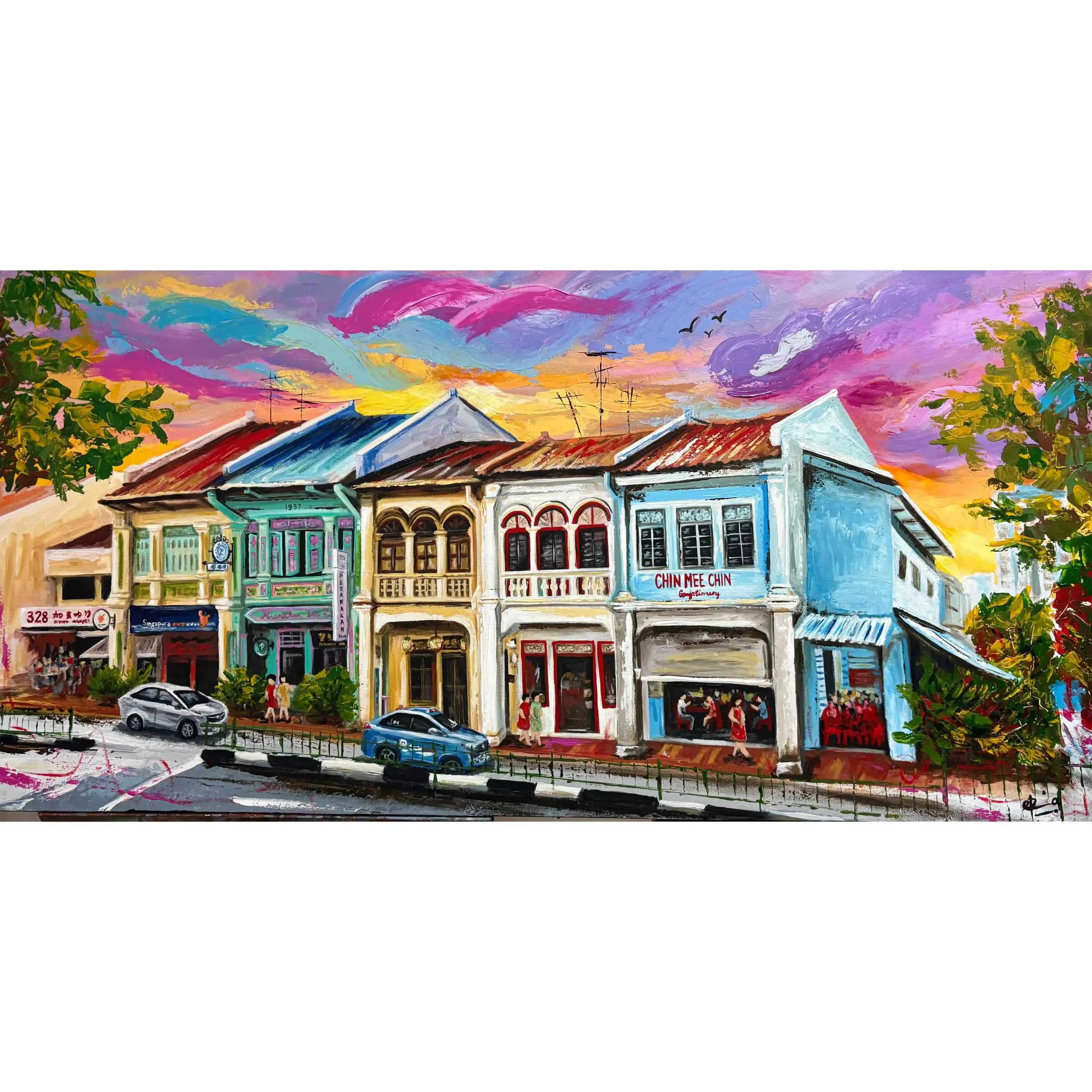
ERICA WEE
61 × 122cm
Acrylic on Canvas
2026
Along this iconic row, vibrant under a technicolor sky, the essence of the old neighbourhood is beautifully preserved - not just in the pastel facades and Peranakan heritage, but in the comforting sensory memories of buttery toasts, rich laksa and aromatic Nyonya Ayam Buah Keluak. It is a visual love letter to a historic streetscape where time stands still, and the stories of our youth remain exactly where we left them.
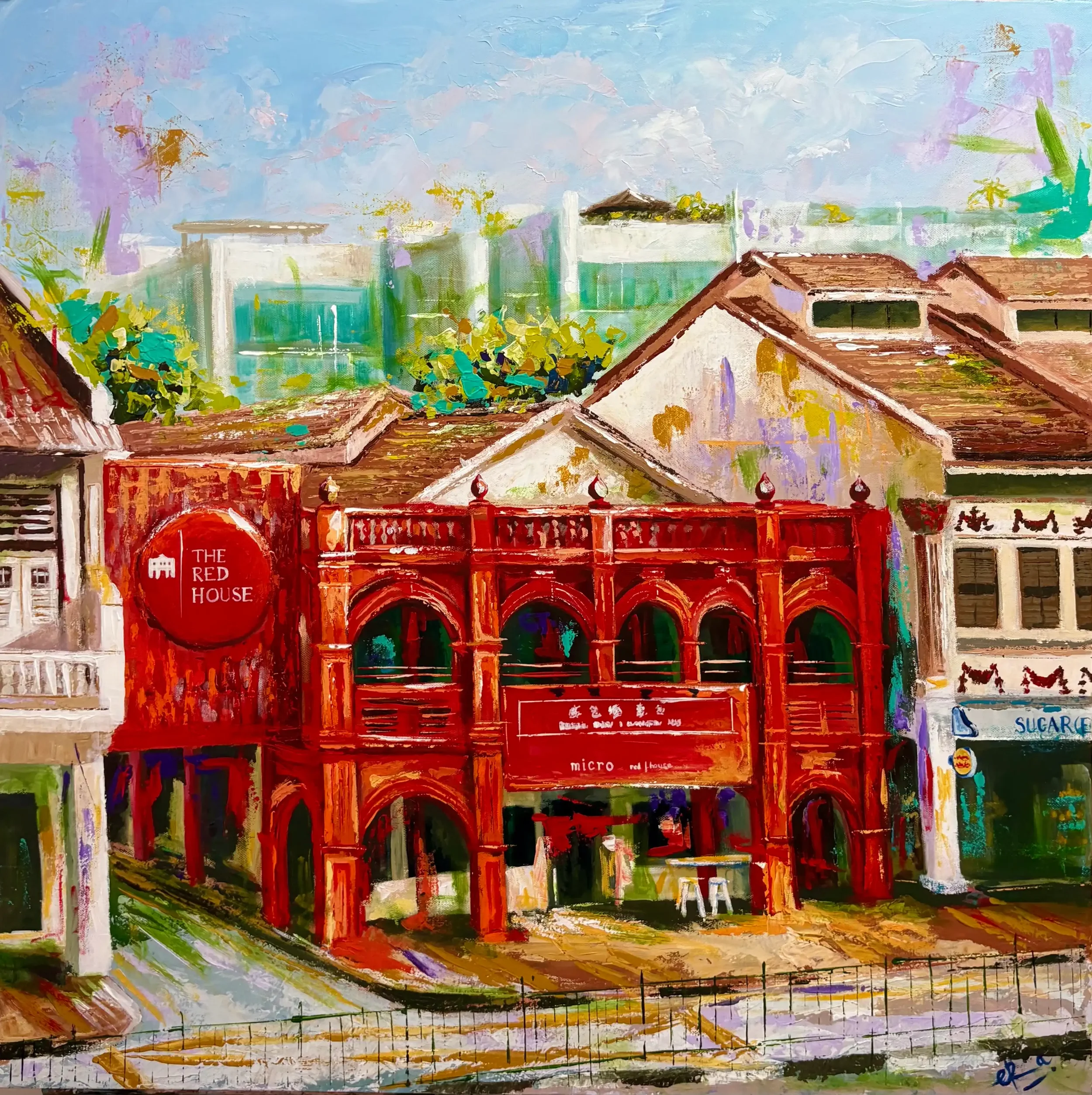
ERICA WEE
80 × 80cm
Acrylic on Canvas (Framed)
2026
The historic Red House Bakery stands as a cherished cornerstone of Katong’s local heritage. Set against the modern backdrop of today’s residential skyline, the vibrant building stands as a striking contrast between the enduring warmth of the past and the clean geometry of the future.
Founded in 1925, this beloved icon remains a vital link to the community’s history, proving that even as the neighbourhood evolves, some landmarks and memories are timeless.
ERICA WEE
90 × 60cm
Acrylic on Canvas (Framed)
2026
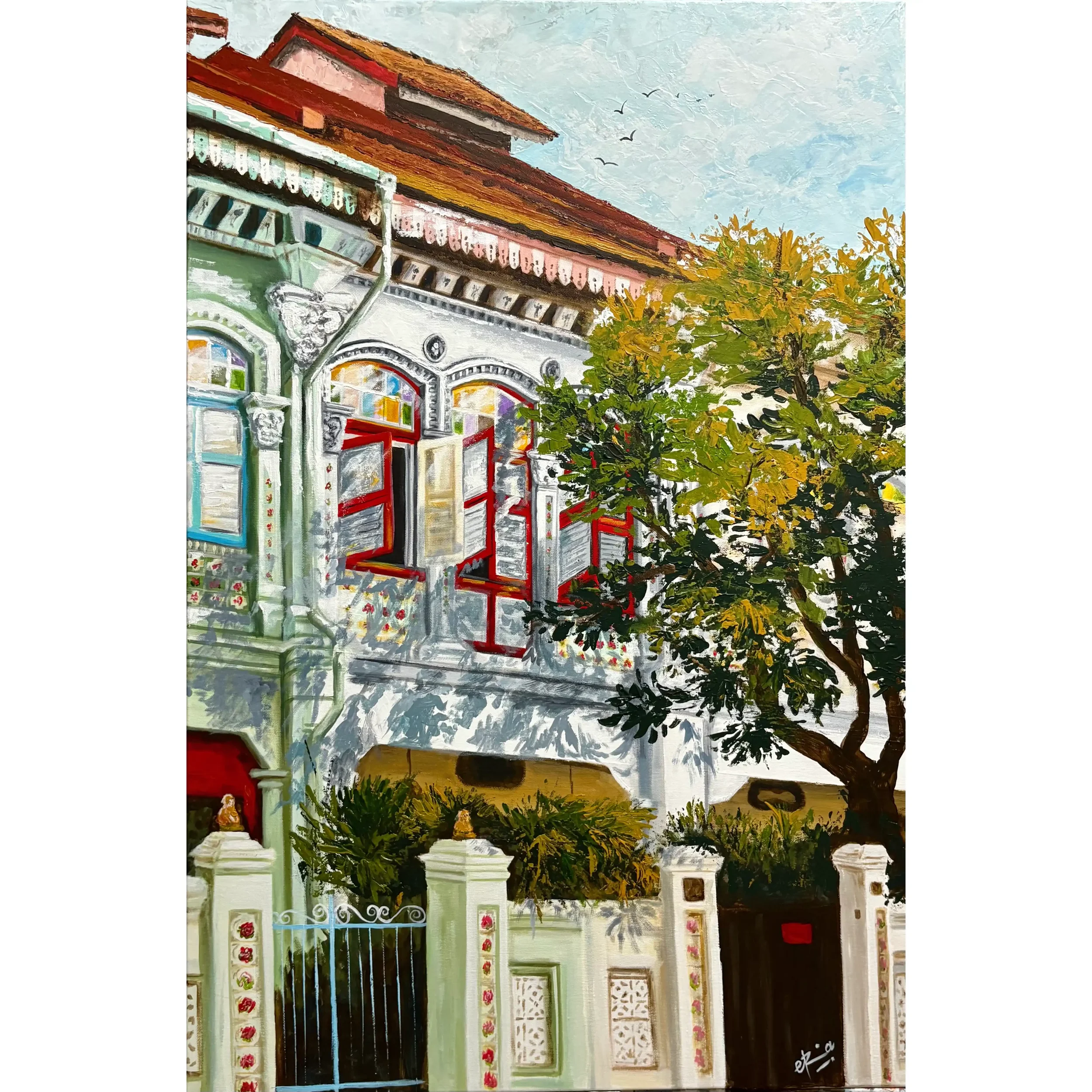
This piece captures the enduring elegance of Koon Seng Road, where the iconic pastel facades of Singapore’s Peranakan heritage intersect with the fleeting geometry of midday light.
By contrasting the intricate, long-lasting craftsmanship of the shophouses with the shifting shadows of the overhanging perennial trees, the piece explores the dialogue between architectural legacy and the passage of time.
ERICA WEE
61 × 122cm
Acrylic on Canvas
2026
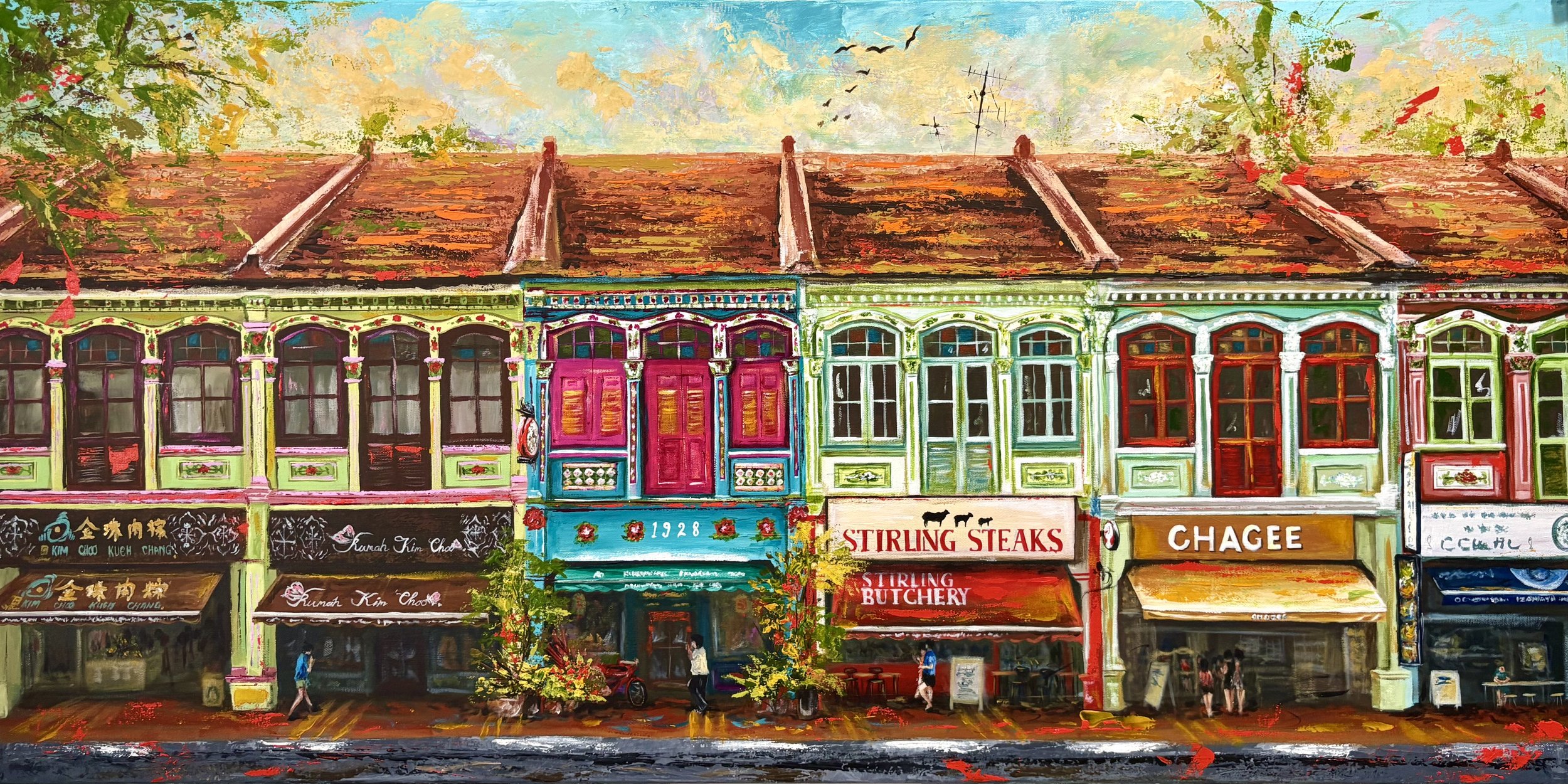
In “Colours of Katong,” the vibrant palettes of historic Peranakan shophouses come to life through thick, textured acrylics, celebrating the neighborhood's unique architectural soul. This piece captures more than just pigment; it reflects the rich heritage and energy of the local community, seamlessly blending the legacy of Katong with the pulse of modern-day life.
From the intricate facades to the figures on the street, the artwork serves as a vivid tribute to the enduring spirit and diverse people that make Katong a kaleidoscope of Singaporean culture.
ERICA WEE
90 × 60cm
Acrylic on Canvas (Framed)
2026
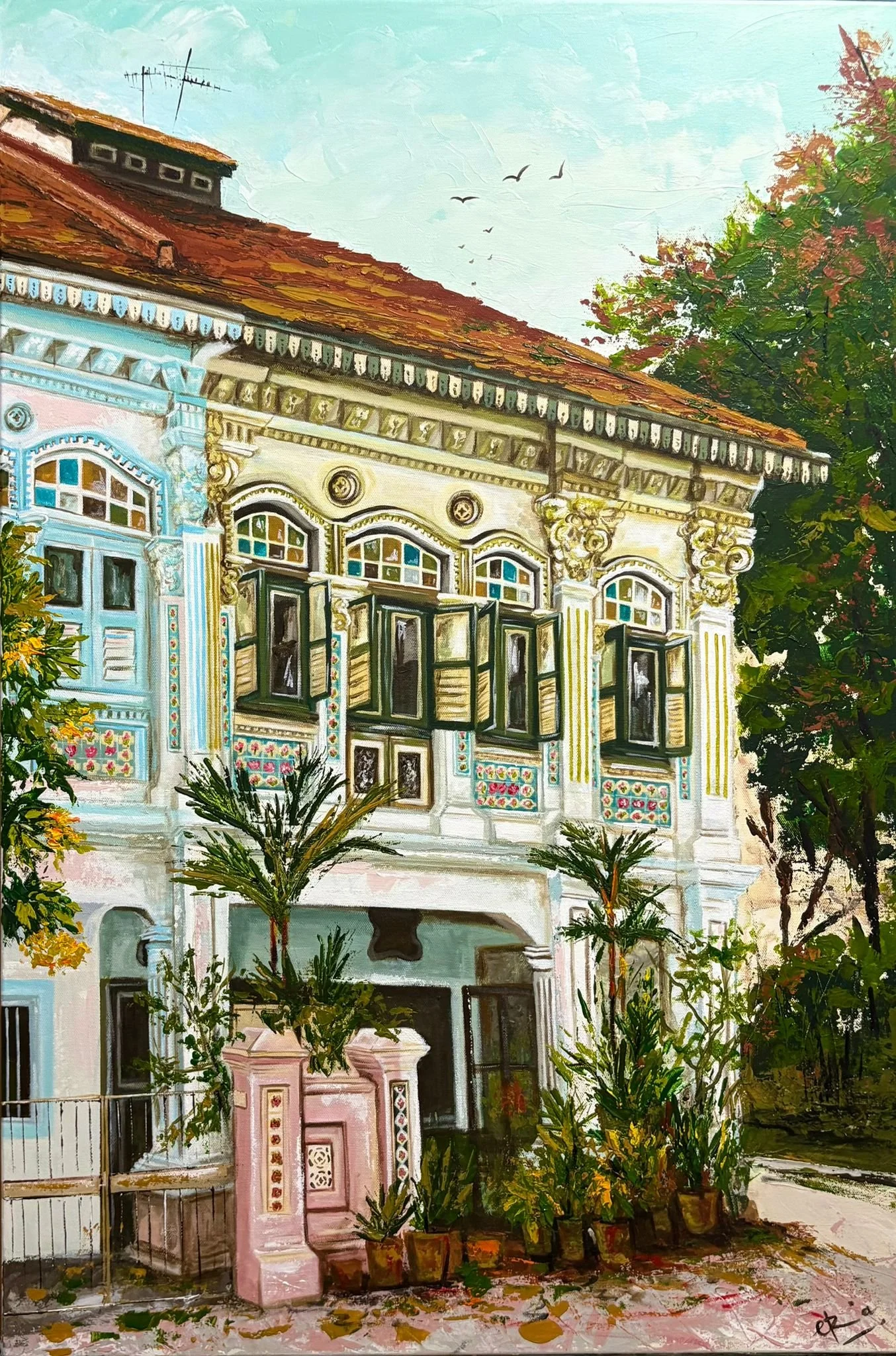
This piece captures the soft hues of heritage shophouses embraced by the iconic frangipani trees and potted palms of Koon Seng Road. It is a dialogue between the structured elegance of the past and the living, breathing greenery of the present—a reminder that on Koon Seng Road, history doesn't just sit still; it continues to bloom.

ERICA WEE
122 × 92cm
Acrylic on Canvas
2025
Mavericks blaze their own trail—visionary, independent, and unafraid to defy convention. They move with purpose where paths are uncertain, driven by instinct and courage.
The white stallion in full stride embodies this spirit, its motion and intensity captured through layers of vivid color and bold textures. Breaking beyond traditional forms, the artwork channels the fearless energy of a true maverick—inviting viewers to think boldly, move freely, and dream without limits.
ERICA WEE
76 × 60cm
Acrylic on Canvas
2025
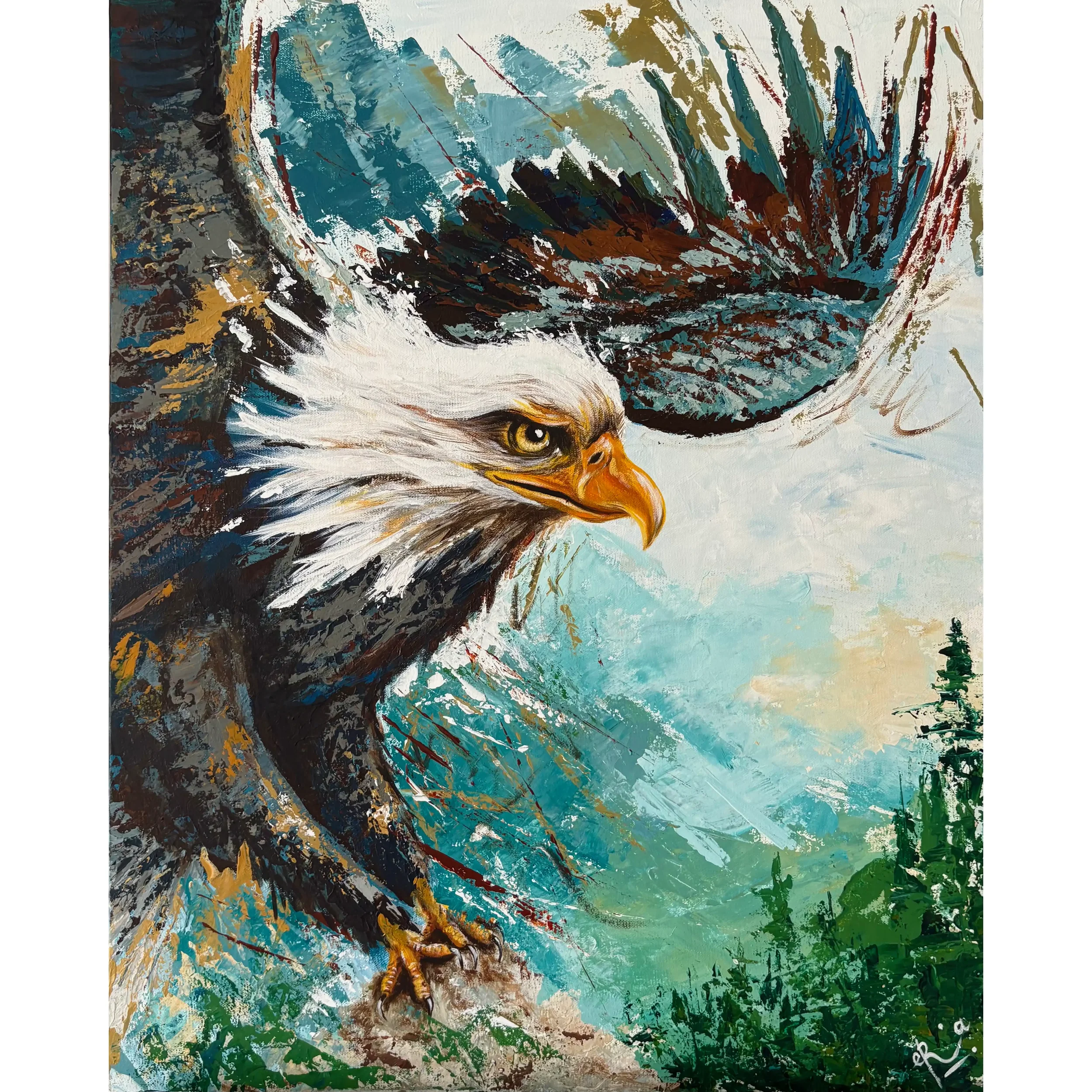
“Landed.” One single word that had become one of the artist’s favourites ever since her children began travelling on their own. Each time she receives a “landed” message, it brings a quiet assurance and comfort.
Echoing Neil Armstrong’s historic declaration, “The Eagle has landed,” the phrase came to represent more than arrival. It speaks of success, accomplishment, and the courage it takes to venture into the unknown and return safely home.
ERICA WEE
100 × 50cm
Acrylic on Canvas
2025
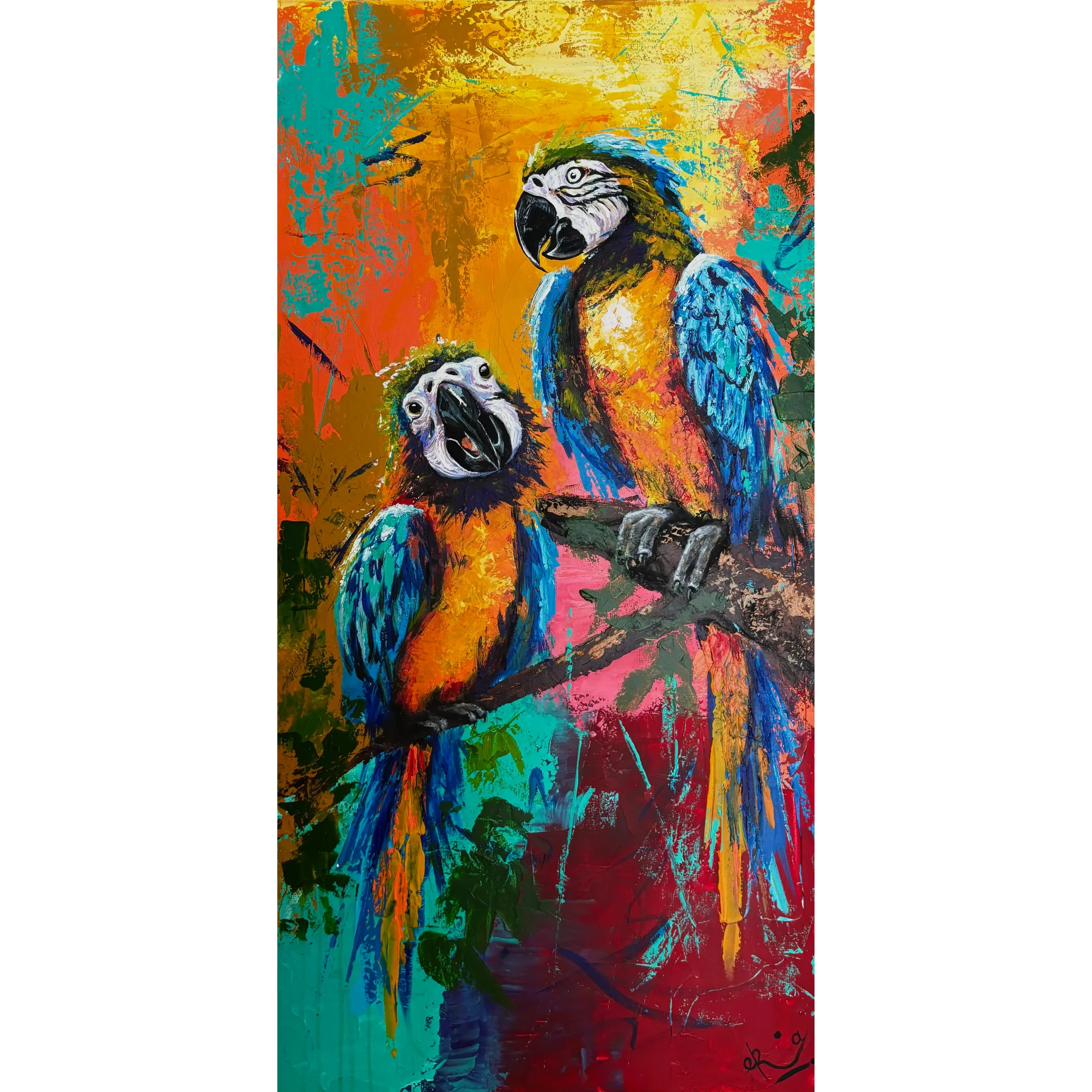
Inspired by the unexpected appearance of two macaws in the artist’s neighborhood, The Boisterous Pair captures the lively energy of the blue and yellow parrots whose bold plumage and loud calls draws a crowd and sends the neighbourhood dogs into a frenzy. Their playful antics of preening and chattering bring their personalities vividly to life.
With expressive brushwork and tropical hues, the piece celebrates the intelligence and charm of these magnificent birds—a joyful tribute to the unexpected beauty in everyday moments.

ERICA WEE
90 × 60cm
Acrylic on Canvas
2025
Only a few inches long, hummingbirds are the smallest of all bird species—yet marvels of endurance and strength. With wings beating up to 80 times a second, they hover, dart, and dance through the air. Symbols of new beginnings, hope, and joy, their iridescent feathers remind us that true strength is not always found in the mighty—for even the smallest flutter can carry great power.
ERICA WEE
80 × 80cm
Acrylic on Canvas
2025
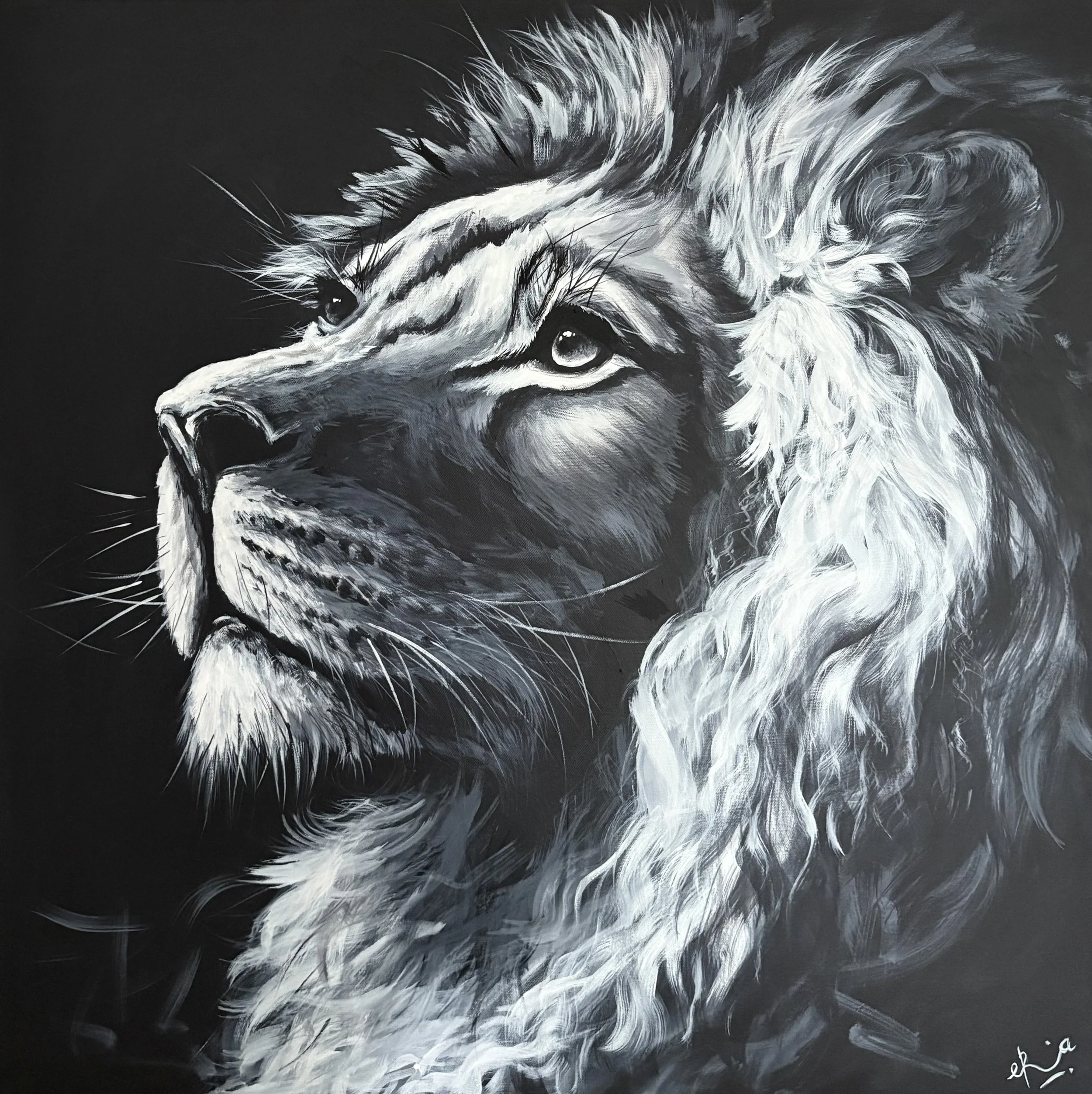
The lion’s gaze lifts beyond the chaos below, carrying a quiet faith and calm strength. With colour removed, the portrait is pared down to its essence: focus, clarity, and peace—reminding us that courage comes not in roaring, but in turning our eyes to what uplifts and restores.

ERICA WEE
40 × 50cm
Acrylic on Canvas (Framed)
2025
This captivating piece features the iconic Mr. Janggut himself, back in the 1940s, when he first sold his famous laksa as a humble street hawker.
Street vendors navigated the watchful eyes of the "Teh Gu" (Sanitary Enforcement Officers). His nickname, "Janggut"—meaning 'beard'— is a curious reference to the mole with long hair on his chin that Erica and many others remember so clearly!
This piece celebrates the ingenuity behind Katong Laksa's unique "shortcut" style, where noodles were famously snipped to allow for quick consumption should an enforcement officer appear—a signature touch that became the brand's enduring trademark.

ERICA WEE
50 × 40 cm
Acrylic on Canvas (Framed)
2025
While these charming spiral staircases intrigue with their intricate forms, Erica's work subtly invites us to consider the lesser-known 'back stories' of these seemingly quaint back alleys. These staircases played a crucial role in the daily rhythms of a past era. They were once vital pathways in a time before modern conveniences, serving households in a developing Singapore.
Erica's artwork pays homage to a fundamental aspect of Singapore's urban evolution and the quiet, everyday lives of its people, all captured through the warm lens of her memories.

ERICA WEE
30 × 60 cm
Acrylic on Canvas (Framed)
2025
In "Joo Chiat Mata Chu," Erica Wee brings to life the colonial-era former Joo Chiat Police Station along East Coast Road, built in 1928. This imposing structure, with its rich history, once served the burgeoning Joo Chiat population.
The painting features the iconic Volkswagen Beetle patrol cars, known colloquially as "Mata Chia," which joined the Police fleet in the early 1970s before being decommissioned by 1982. While the building today houses modern establishments like Hotel Indigo Singapore Katong (a Peranakan-themed boutique hotel) and Baba Chews, Erica's artwork is a testament of its formidable past

ERICA WEE
60 × 30cm
Acrylic on Canvas (Framed)
2025
Here, Erica meticulously depicts one of Katong-Joo Chiat's most cherished and photographed landmarks. These picturesque two- to three-storey shophouses, built in the 1920s and 1930s, exude charm with their vibrant Peranakan and eclectic Chinese architectural styles, a beautiful reflection of their early inhabitants.
For 12 years in the 1990s, Erica called Koon Seng Road home. While this iconic row now draws a constant stream of visitors, Erica's painting invites us to experience these timeless Katong homes through the vibrant lens of her treasured childhood memories.
ERICA WEE
50 × 40cm
Acrylic on Canvas (Framed)
2025
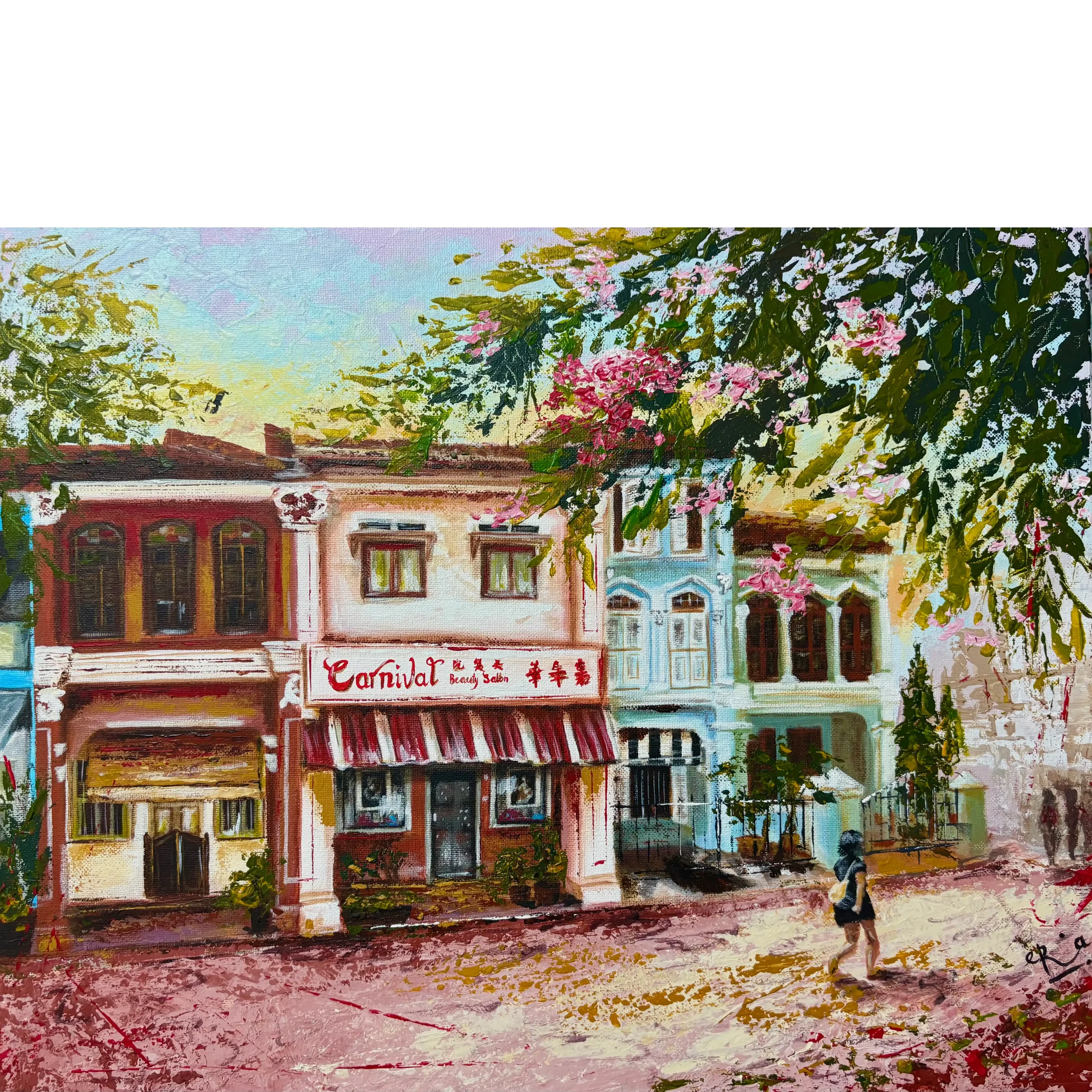
In this charming pastel piece, the artist lovingly captures a timeless gem from her Katong memories, inviting us into a world that seems to have come to a pause amidst the rush of modern life.
Tucked quietly along Ceylon Road, nestled among private homes, this quaint little hair salon stands as a testament to enduring local charm. Opened in 1960, Carnival Beauty Salon is portrayed with all its delightful, retro character. Remarkably, the salon continues to operate today, a true survivor of Katong's ever-changing landscape, albeit with a more intimate clientele.
It echoes the timeless adage: "Friends come and go, but a good hairstylist is forever!"
ERICA WEE
40 × 50 cm
Acrylic on Canvas (Framed)
2025
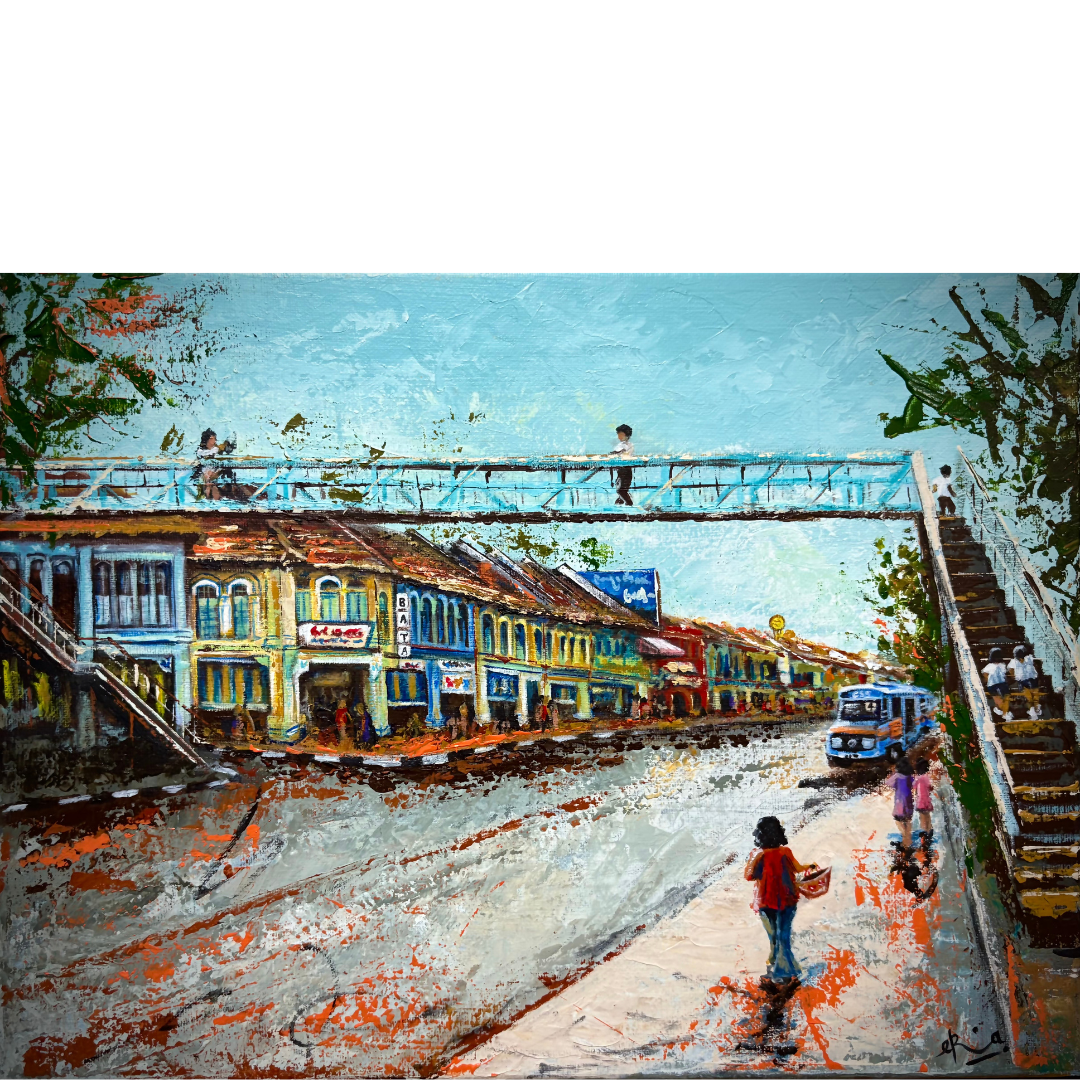
Before the widespread concrete structures we know today, Katong's pedestrian overhead bridges were charmingly humble.
Erica brings to life simple structures of steel tubing and timber plank decking. One can almost feel the slight tremor underfoot! She fondly recalls that it took guts and concentration to skip over loose, worn-out planks high above ongoing traffic—a playful, yet thrilling, rite of passage for many a child growing up in Katong.
Below, the street teems with subtle activity, anchored by a vibrant blue CSS Bus 4. A poignant symbol of a bygone era, these beloved blue buses ceased operations by 2007, marking a gentle shift in Singapore's evolving urban landscape.

ERICA WEE
50 × 50 cm
Acrylic on Canvas (Framed)
2025
Two sailboats drift in the distance, accompanied by the graceful flight of seabirds. Erica Wee’s signature palette knife technique infuses the rugged beauty of the open waters with a sense of adventure.
“We're adrift on a sailboat
My love is the sea
Yours is the horizon
Constant and steady” — Brooke Fraser, Sailboats

ERICA WEE
60 × 90 cm
Acrylic on Canvas
2025
Bathed in the serene hues of a pastel sunset, "Lavender Embrace" is a tranquil contemplation of nature's artistry. Stripped off any human or creature in sight, the canvas instead breathes with soft washes of pink, lavender, and peach that often accompany the warmth of the day.
Here, the sky and stream engage in an unspoken mirroring, merging into a seamless expanse of purple tones.

ERICA WEE
Hand-Embellished Fine Art Paper Reproductions (Framed)
2024
Available in 2 sizes:
30 × 40cm
40 x 50cm
Featuring forgotten Traders and Places, Katong of Yesteryear is a series of digital artworks by artist Erica Wee which revisits professions and locations around Katong in the 1960s to 1980s. Most of these professions have now either become obsolete due to a lack of apprenticeship or have marched off to the drumbeat of commercialisation.
What is hand-embellishment?
Hand-embellishment is a technique where an artist applies his/her unique touch of detailing to a fine art print, making it look more textured, and closer to an original than a simple art print; it elevates the value of the art work.
As the embellishment is done by hand, every piece will be one-of-a-kind.
For this pop-up exhibition, artist Erica will add on textures to the fine art prints in acrylic paint, making certain details and highlights of the artwork pop.
Roadside Cobbler
As a child, Erica used to enjoy squatting by the side of the Cobbler outside the Old Red House Bakery, fascinated by his skillful craft. Traditional cobblers were once a common sight in Singapore, after people switched from wearing wooden clogs to modern footwear in the 1950s. Setting up along five-foot-ways in front of shophouses and on street pavements, these skillful cobblers replaced old soles and heels, and stitched up torn slippers.
Street Barber
Sitting on wooden planks above a large drain off East Coast Road, one could get a haircut, a clean shave, and a strong head and shoulder massage. As a little girl, Erica used to accompany her father whenever he went for his haircut. Sitting on a tiny wooden stool, it was intriguing to watch the barber at work.
Trishaw Ride Home in Katong
As a kindergartener, it was always a treat for Erica whenever she got to ride home from school on the trishaw. By the late 1960s, rapid technological developments and the increasing accessibility of cars saw the trishaw becoming less popular as a mode of transportation in Singapore. By the 1980s, trishaws completely phased out as a means of travel for locals.
Night Soil Collector
Many of us are intrigued by these charming spiral staircases in quaint alleys of Singapore. “Night Soil”, a euphemism for human excreta, came about as the waste was collected in buckets at night by workers. They climbed up these spiral staircases to retrieve “night soil” from each floor.
Singapore in the 1970s was still largely rural and unsewered. By the late 1980s, Singapore’s sanitation system progressed entirely to the flush toilet, thus phasing out the night soil bucket system.
Rattan Furniture Weaver
“Rattan” refers to the stem of a climbing palm found in tropical regions. In Singapore, the making of rattan products is closely tied to its economic history. Historically known as the centre for entrepot trade of rattan, the rattan industry in Singapore reached its peak in the 1960s- 1970s, when there was a rapid growth in the processing of rattan raw materials and making of rattan products.
One of the few remaining rattan furniture shops in Singapore can still be found in Joo Chiat today.
Travelling Satay Man
While Singaporean’s love for Satay is still very much alive today, the Travelling Satay Man, with his iconic bamboo-woven fan, is no more. At the former Katong Park in the 1960s-1970s, the Travelling Satay Man used to barbecue his skewers of well-marinated meats over a flaming fire on a portable charcoal grill. Sitting beneath coconut trees with an expansive view of fisherman’s boats and outhouses built on poles over the water, these simple pleasures have all disappeared when the coastal land was reclaimed in the 1970s.
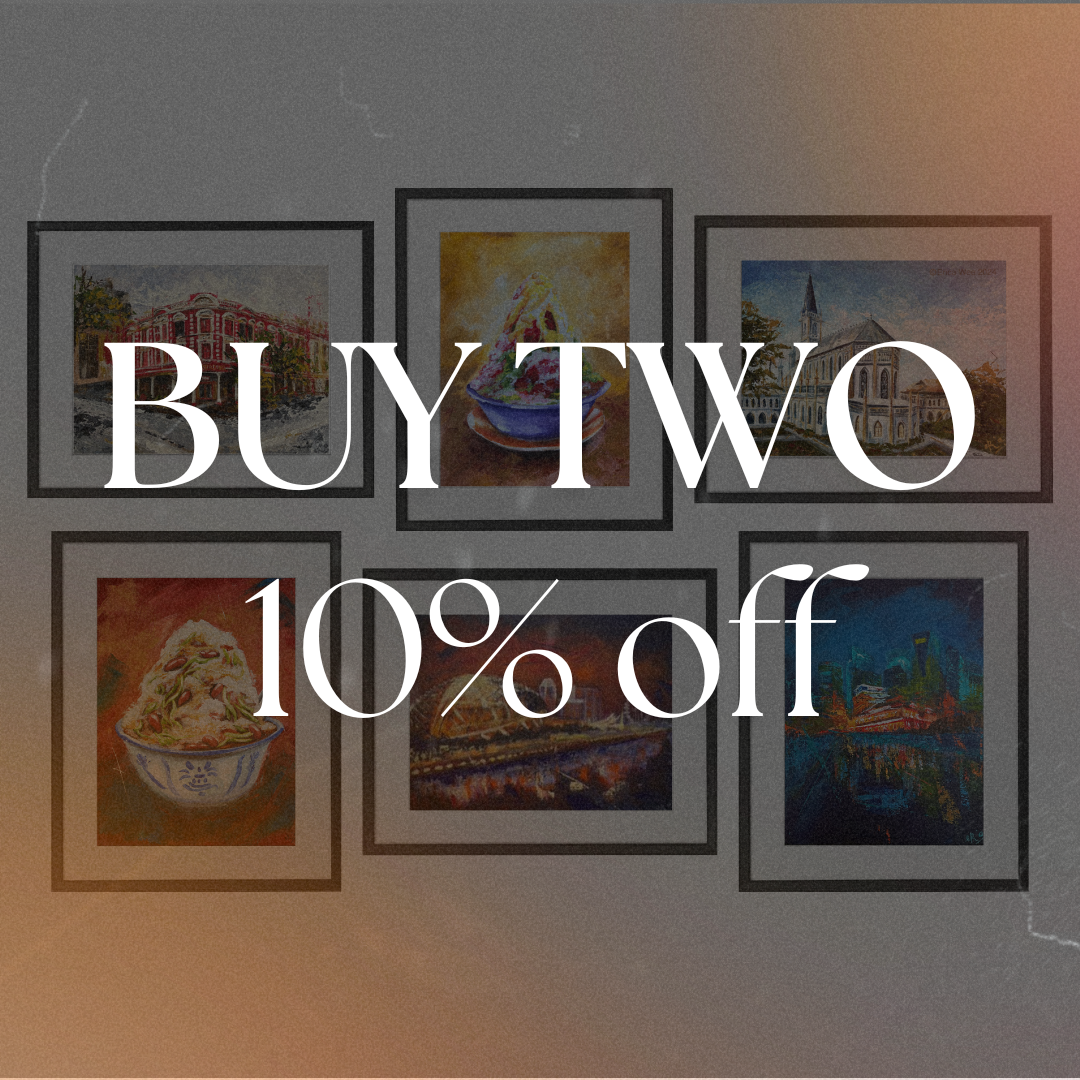
ERICA WEE
Hand-Embellished Fine Art Paper Reproductions
40 x 50cm (Including Frame)
An Exclusive Embellished Print Launch with HomesToLife of Erica Wee’s Popular Works
These fine art paper prints are being released for the first time with Homes to Life for National Day this year! Embellished by hand by Erica herself, these one-of-a-kind prints tell of Erica’s memories and experiences growing up in Singapore.
Usual Price per framed print: $300
National Day 2024 Promotion - choose from any 6 of the designs and save:
Buy 1 (save 5%), Buy 2 (save 10%), Buy 3 (save 15%)
What is hand-embellishment?
Hand-embellishment is a technique where an artist applies his/her unique touch of detailing to a fine art print, making it look more textured, and closer to an original than a simple art print; it elevates the value of the art work.
As the embellishment is done by hand, every piece will be one-of-a-kind.
For this campaign, artist Erica will add on textures to the fine art prints in acrylic paint, making certain details and highlights of the artwork pop.
For orders of more than 3 prints (15% discount will be maintained), please contact us directly at esther@soundof.art
Artist Profile
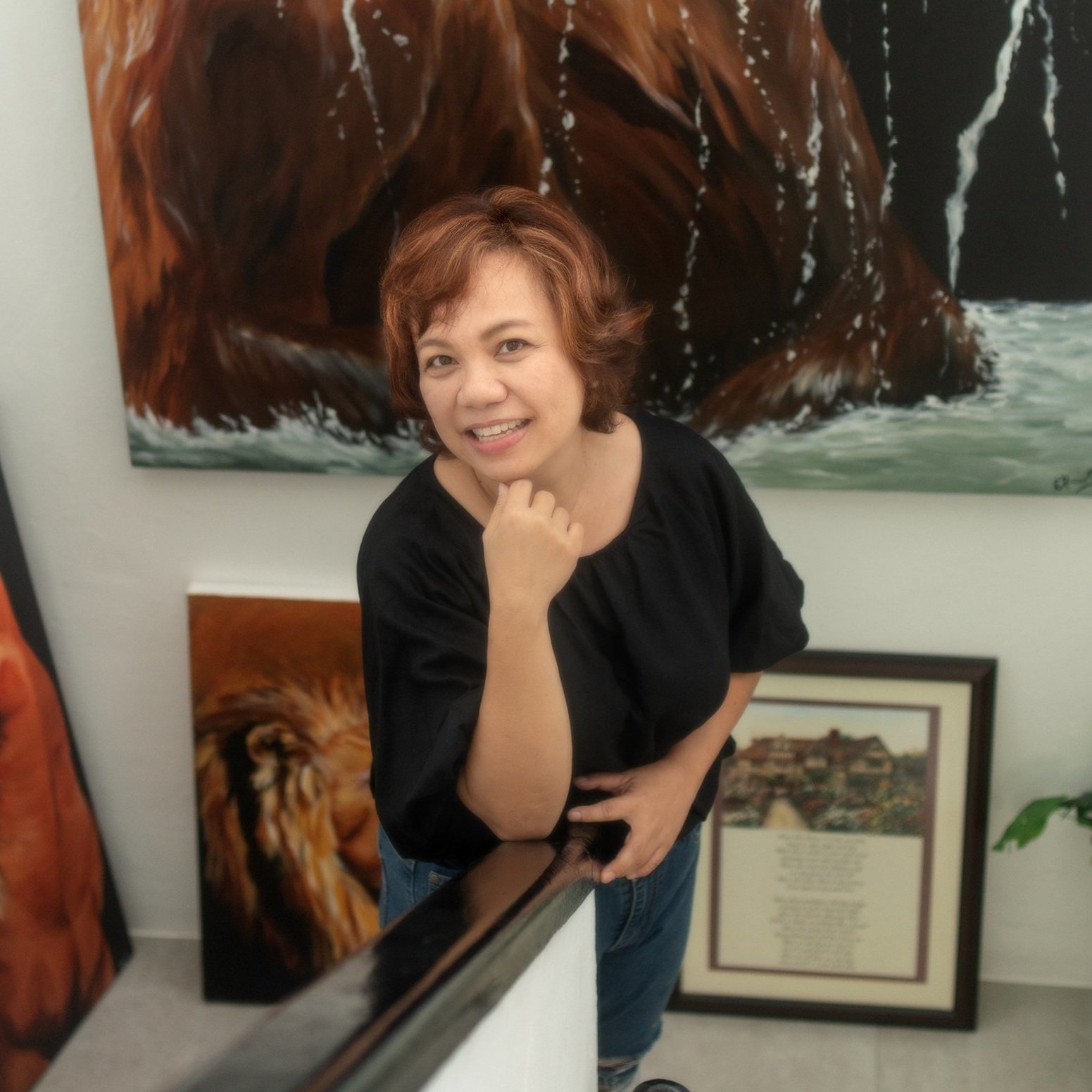
Singaporean artist, Erica Wee relocated with her family to Kuala Lumpur in 2007. After graduating from the University of Washington, Seattle, in 1992, she put aside her art passion and paintbrushes to focus on her family and on her corporate and entrepreneurial career.
In 2016, after a hiatus of over 25 years, Erica picked up her long-forgotten painting brushes and fell in love all over again.
A self-taught artist, Erica works mainly with Acrylic and Oil. Representational and figurative, Erica’s art captures the realistic nature of her subjects, interjected with an abstract touch - so they are traditional, yet styled with a daring modern slant; realistic, yet juxtaposed with a dramatic edge. The results are bold, uplifting “statement artworks” on huge canvases which are as energetic and vivacious as the artist herself.
To Erica, art is a never-ending journey of growth. She is always learning, always challenging herself, and always evolving her art. She enjoys creating in different styles of contemporary realism, minimalism, still life, pop art, and even mural art.
“Art cannot change the world, but it can contribute to changing the consciousness and drives of the men and women who could change the world.”
– Herbert Marcuse, German-American philosopher
In a world where much negativity exists, Erica aspires to share a twinkle of positivity and hope through her art.
Erica is now back in Singapore with her family and two Chinese Shar-Pei’s who love nothing more than cozying into their favourite positions next to Erica’s painting easels.
ERICA WEE
76 × 101cm
Acrylic on Canvas
2026
Framed by the iconic Peranakan architecture of Katong, this artwork traces the continuum between past and present. The timeless craft of classic shophouse facades meets the vibrant pulse of contemporary life, capturing how history isn't just preserved in brick and pastel—it is lived, adapted, and carried forward by every generation that gathers along East Coast Road.